
Assets that vanish from a register are not always stolen: many are sitting in another office, awaiting repair, assigned to a relocated employee or still recorded after disposal. You will be able to separate true losses from location and recordkeeping errors, then build a recovery process that keeps Mumbai offices, warehouses and project sites aligned.
Key takeaways
- Reconcile transfers, repairs, loans, disposals and duplicate tags before declaring an asset lost.
- Sweep offices, branches and project sites using a controlled list, route and exception log.
- Require transfer approval, destination, custodian and timestamp for every asset movement.
- Choose barcode for line-of-sight scans and RFID for rapid, repeated movement checks.
Find out why assets disappear from the Mumbai register
An asset is not necessarily lost because it is absent from the Mumbai register’s expected room. Business asset visibility problems in Mumbai often come from an incorrect record: an unapproved transfer, employee relocation, remote-work issue, temporary loan, repair vendor, project-site move, duplicate tag, unrecorded disposal, wrong floor or wrong cost centre.
Build a location hierarchy that narrows the search:
- Legal entity
- Mumbai site
- Building
- Floor
- Room or zone
- Department
- Custodian
- Cost centre
Record the last verified location separately from the current location and current custodian. “Mumbai office” is too broad to support a physical search.
Use an immutable asset ID, not a room number, employee name or changing cost-centre code. Minimum record fields are:
- Asset ID, description, serial number, manufacturer and model
- Acquisition date, original cost, custodian and business unit
- Status, location code, last verification date, transfer date and evidence reference
- Condition and capitalization status when they affect reporting
Define status values precisely: active, in transit, under repair, assigned to employee, stored, missing, found, disposed and transferred. A missing asset must not remain active at its former location.
Link detachable components to a parent asset. A server module, printer accessory, laboratory instrument component or meeting-room controller can disappear while the complete-looking parent record remains. Check the transfer, repair, disposal and handover evidence before calling the asset lost.
Run a controlled recovery sweep across offices, branches and sites
Freeze the master register before the sweep begins, allowing only approved emergency transactions. This prevents late edits from hiding discrepancies or creating duplicate movements.
1. Divide offices, branches, warehouses and project sites into batches by legal entity, building, floor, warehouse zone or project site. Name one site owner and one verifier for each batch, then publish the included rooms, storage areas, loading zones, basements and service floors.
2. Run book-to-floor checks to confirm every recorded asset is present. Run floor-to-book checks to capture unregistered or transferred-in items.
3. Classify each exception as found at the recorded location, found elsewhere, not found, duplicate ID, untagged, disposed, under repair or record mismatch. An asset found in one office but assigned to another needs a transfer or location-correction record, not a simple scan.
4. For assets missing across company locations in Mumbai, obtain custodian confirmation, search nearby rooms, check repair and vendor logs, review transfer records, contact the destination site, and escalate by value and age before proposing a write-off.
5. Resolve conflicting evidence rather than forcing a match. Photograph any serial number that differs from the register and preserve both values. Replace an unscannable barcode only after verifying the asset ID.
6. Quarantine a tag fixed to the wrong item and correct both records. Give identical equipment without readable serial numbers a controlled temporary ID linked to its model, room, custodian and image.
7. Record every approved correction with its evidence reference, including transfer, disposal, repair or location change. A scan alone does not prove ownership or destination.
Make every movement prove where the asset went
Recovered assets disappear again when dispatch happens without a transaction that someone at the destination must accept. To track assets across multiple offices in Mumbai, make the movement record the proof of custody.
1. Require approval before dispatch. Record the source location, destination location, requester, approver, dispatch time, receiving verifier, receipt time, condition and handover, courier or project reference. Set the asset to in transit until acceptance; never show it as active at both offices.
2. For employee relocations and remote work, record the employee, issue date, expected return date and approved home or temporary location. Link under-repair assets to the repair vendor and expected return date.
3. Keep a disposed asset in disposed status only after attaching a disposal certificate, sale document, destruction record or approved handover evidence. Preserve the scan trail, exception approvals and register adjustments.
4. Build the mobile workflow for basements, loading areas, leased floors and restricted rooms. Offline capture, queued synchronisation, timestamped photographs, GPS or site confirmation and a visible sync-error queue stop weak connectivity from creating false completion.
5. Review coverage, found-at-recorded-location, found-elsewhere, not-found, duplicate IDs, untagged items, assets without serial numbers, overdue transfers, reconciliation differences and unresolved exceptions by age and value. These records support management review and, where applicable, the Companies (Auditor’s Report) Order, 2020 requirements on particulars, physical verification and material discrepancies.
Choose barcode or RFID based on the movement problem
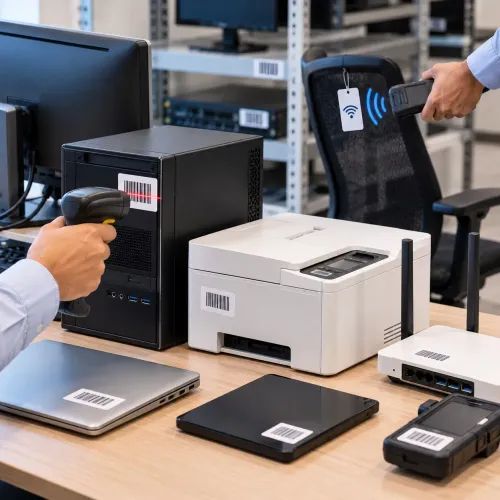
A barcode register is enough when asset volumes are manageable, labels remain visible, staff can reach each item and movements are infrequent. It is inexpensive, easy to replace and works with a phone or handheld scanner, but every item needs line of sight, correct label orientation and a deliberate scan.
| Option | What it requires | When it applies |
|---|---|---|
| Barcode | Visible label, reachable asset and item-by-item scan | Manageable volumes and infrequent transfers |
| UHF RFID | Tags, readers, software, testing and trained operators | High volumes, frequent transfers, restricted access or group scanning |
| Barcode plus RFID | Separate controls for different asset and room conditions | Mixed sites where some assets scan easily and others do not |
Choose RFID when the scanning workload itself prevents reliable coverage. Test actual rooms, elevators, racks, cabinets, storage conditions and tagged surfaces; measure read rate, duplicate reads, false reads and missed reads. Metal cabinets, servers and racks can detune ordinary tags, while liquids and tightly packed equipment can alter the RF field.
RFID is not continuous indoor location tracking. A doorway or handheld read proves detection at that scan event, not permanent presence, so require an approved movement transaction and destination acceptance to track assets across multiple offices in Mumbai.
For business asset visibility problems in Mumbai, Welcome to V SOURCING can compare the tagging method, physical-verification workflow and software controls at each site. Use RFID to remove a scanning bottleneck, not to compensate for weak approvals or poor record discipline.
Related products
FIXED ASSET MANAGEMENT refers to the systematic process of acquiring, tracking, maintaining, and disposing of a company's fixed assets. View product → |
FIXED ASSET PHYSICAL VERFICATION TAGGING & BARCODING SERVICES FIXED ASSET PHYSICAL VERFICATION TAGGING & BARCODING SERVICES Fixed Asset Physical Verification and Tagging entails the following activities : Comprehensive and complete physical verification exercise of all the... View product → |
Turn the recovery exercise into a permanent visibility control
Keep visibility reliable by checking assets according to risk, not on one identical annual cycle. Check high-value, portable, regulated and frequently moved assets more often than fixed, low-risk furniture. Use sampling only when you document the population, selection method, confidence target, tolerable error and exception treatment; convenient rooms do not prove site coverage.
- Set a verification interval for each risk class and record its owner.
- Keep the asset ID permanent; put only that ID or a QR code on the visible tag.
- Store cost, employee association, warranty documents and disposal approvals behind role-based access.
- Link components through parent-child records, and require receiving confirmation for every transfer.
- Review exception ageing at a monthly control meeting, escalating by asset value, business criticality and days unresolved.
Do not make “assets verified” your main result. Report coverage, accurate-location rate, found-elsewhere rate, not-found value, duplicate IDs, untagged assets, overdue transfers, sync failures and register adjustments. A lost asset for visibility across business locations in Mumbai is not resolved until its evidence trail explains what happened.
An ISO 55001-aligned governance approach can organise ownership, risk, evidence and continual improvement. It does not choose your tag, reader or verification interval. The practical test is simple: can a manager identify who has the asset, where it was last confirmed and what evidence supports that answer?
Frequently asked questions
Why do assets go missing from a Mumbai business asset register?
Common causes include unapproved transfers, employee relocation, remote work, temporary loans, repair vendors, project-site moves, duplicate tags, unrecorded disposals, incorrect floors and wrong cost centres.
How do you run a recovery sweep across Mumbai offices and sites?
Use a controlled asset list, assign teams and routes, scan or inspect each location, record exceptions, and reconcile findings against custodians, rooms, cost centres and movement documents.
What information should prove where an asset moved?
Record the asset ID, previous and new locations, destination custodian, transfer approval, movement date, reason, condition and receiving confirmation.
Should you use barcodes or RFID to track assets across multiple Mumbai offices?
Use barcodes when staff can scan each item directly and movement volume is moderate. Use RFID when you need faster repeated checks across rooms, storage areas or high-volume equipment flows.
Related products
FIXED ASSET REGISTER CREATION A fixed asset register is a detailed list of all fixed assets which are owned by a business. View product → |
AUDITING AUDITING At V Sourcing we undertake specialized Audits like:- 1- Liquor Audit. 2- Liquor Excise Data Updation. 3- Stock Audit 4- Internal Audits. |
IT SERVICES At V Sourcing we provide you with best in Class IT with our Homegrown products that can service your complete business needs. View product → |
Keywords