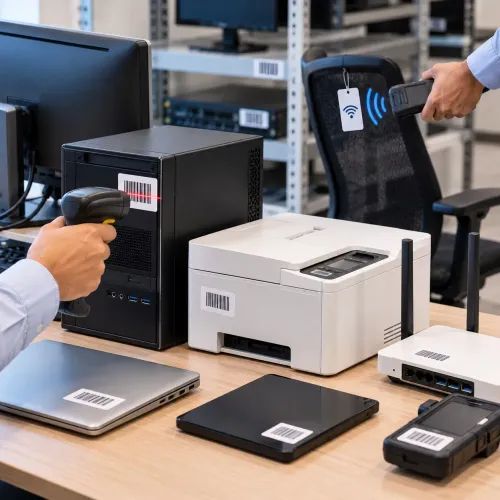

IT services for a business extend beyond answering support tickets: they can cover devices, networks, cloud platforms, security, backups, software, physical assets and onsite work. Before you book an IT service provider in India, you will be able to define the scope, compare support models, test SLA promises and prepare the records and access information the provider needs.
Key takeaways
- Demand a written scope covering endpoints, networks, cloud, security, backups and user support.
- Choose managed IT for continuous prevention, break-fix for occasional faults, and projects for defined deployments.
- Check SLA response, resolution, uptime, escalation and exclusions instead of accepting vague support promises.
- Require an asset register, credentials handover plan, RFID evidence and documented disposal certificates.
What should a complete IT service scope cover?
A complete IT service scope names every asset, system, control and support activity instead of using “IT support” as a catch-all. The question “what do IT services include for businesses in India” should produce a written scope covering:
- Equipment: laptops, desktops, servers, printers, routers, switches and firewalls.
- Operations: networks, cloud systems, SaaS applications, endpoint administration, patching, cybersecurity controls and backups.
- Support: software support, help-desk support, monitoring and onsite assistance.
- Lifecycle control: asset records, warranty tracking, disposal coordination and management reporting.
Require the statement of work to list included services, exclusions, deliverables and your responsibilities separately. It should also define supported sites, working hours, remote versus onsite work, travel charges, spares and acceptance criteria.
Physical verification is not an asset audit or a statutory financial audit. A count locates equipment and records condition, custodian and site exceptions; it does not replace the statutory auditor or decide accounting treatment. Require an exception register covering:
- Assets found elsewhere or without tags
- Duplicate records and disposed assets still listed
- Idle or damaged assets
- Leased assets and assets with unclear ownership
An asset tag identifies equipment; it does not prove ownership, cost or accounting value. Ind AS 16 decisions remain separate from the operational count. Also require software and cloud records to state licence entitlement, renewal dates, unsupported systems and cloud-resource ownership, because a hardware count cannot prove software compliance.
Which support model fits your business: break-fix, managed or project-based?
Break-fix, managed and project-based support serve different buying decisions. Choose break-fix only when your environment is small, stable and able to absorb downtime; it offers weak prevention and makes monthly effort unpredictable.
| Option | What it means | When it applies |
|---|---|---|
| Break-fix | You pay after a fault occurs | Small or stable environments that accept downtime |
| Managed | A provider continuously monitors and maintains IT | Businesses needing predictable ownership and recurring support |
| Project-based | A provider delivers a defined outcome with handover | Migrations, installations, replacements or software rollouts |
Fully managed support assigns recurring responsibility for remote monitoring, alert handling, patch management, device administration, user support, backups, security checks and scheduled maintenance. It is a poor fit when your internal team wants to approve every administrative action, or when the provider cannot support every required branch.
Project-based work has a start date, scope, acceptance criteria and handover. A cloud migration, office network installation, firewall replacement, endpoint deployment or software rollout does not include ongoing support unless the contract says so.
Combining models often works best: use a project to migrate systems, then managed support to maintain them. Treat a managed IT solutions India proposal as incomplete until it answers these questions:
- Who owns alerts and approves changes?
- Who supplies spare devices and replacement parts?
- Who attends a branch onsite, within what travel boundary?
- What happens after project handover, and what support is excluded?
Which SLA terms reveal the real level of support?
A four-hour acknowledgement proves only that someone received your ticket. It does not promise an engineer, replacement device, workaround or fix within four hours.
| Priority | Example | Compare these promises |
|---|---|---|
| P1 | Complete business outage | Response, workaround or restoration, permanent resolution, onsite arrival |
| P2 | Confirmed security incident | Response, containment or restoration, permanent resolution, onsite arrival |
| P3 | One unavailable application | Response, workaround or restoration, permanent resolution, onsite arrival |
| P4 | Single-user fault | Response, workaround or restoration, permanent resolution, onsite arrival |
Ask an IT service provider in India to state each time separately. “Four-hour support” is too vague for business technology services in India.
Check these SLA terms before signing:
- Uptime percentage, measurement method and planned maintenance windows.
- After-hours coverage, escalation path and named contacts.
- Supported offices, branches and remote workers; remote versus onsite support.
- Travel charges, emergency work rates and spare-part ownership.
- Service credits, exclusions, change-control steps and acceptance criteria.
- Liability for lost or damaged equipment.
Ask whether the SLA reports breached targets, not only closed tickets. A ticket closed after repeated delays can make performance appear healthy.
Confirm that coverage includes your branches and home-based staff, not just the registered office. Assign responsibility for alerts, logs and cyber-incident reporting; where CERT-In directions apply, covered entities must retain ICT logs for 180 days and report specified incidents within six hours.
What must be inventoried and handed over before onboarding?
Before onboarding, hand over a complete inventory of technology, contracts and source records—not just a spreadsheet of equipment.
1. List laptops, desktops, servers, routers, switches, firewalls, printers, SaaS applications, domains, software licences, user accounts, cloud subscriptions, warranties and support contracts. Include serial number, asset identifier, custodian, site, status, ownership and renewal date.
2. Provide the network diagram, asset list, fixed-asset register, purchase ledger, IT service-management database, procurement records, lease schedules, prior disposal records, vendor contracts, warranty records, backup logs and software-licence records. Agree which source is authoritative, how locations are structured, which asset identifier controls reconciliation and how leased, owned and customer-held assets are classified.
3. Treat software and cloud controls separately from the hardware count. Confirm licence entitlement, renewal dates, unsupported systems, security-update status and cloud-resource ownership. A managed IT solutions India proposal that covers only devices will not reveal an expiring licence or an abandoned cloud instance.
4. Transfer credentials through a password manager, temporary named accounts or an approved secure vault; never email administrator passwords in plain text. Require least-privilege access, named users, credential rotation and a record of every permission granted.
The contract must specify collected data fields, retention period, subcontractors, breach handling, and deletion or return duties under India’s Digital Personal Data Protection framework. Allocate ICT-log retention and incident reporting: covered entities must retain logs for 180 days, and specified cyber incidents require reporting to CERT-In within six hours when its directions apply.
How do you test a provider’s asset, RFID, security and disposal claims?
1. Ask an IT service provider in India for a sample evidence pack: the pre-count register, count date and personnel, location-wise count sheets or device logs, required photographs, approved exceptions, adjustment entries and post-reconciliation register. Missing links make branch moves, contractor-held equipment and repair transfers impossible to defend.
2. Test the tagging rules before approving barcode or RFID work. Require a tag-number structure, duplicate-prevention rule, placement and replacement standards, tamper handling and records containing serial number, manufacturer, model, configuration, custodian, site, status, acquisition data, warranty and verification history. A tag identifies equipment; it does not prove ownership or accounting value.
3. Insist on an RFID demonstration in your actual rooms, not a quoted laboratory range. Metal, liquids, racks, cable bundles, tag orientation and reader placement change performance. Require zone-by-zone reads, duplicate suppression, a physical sweep for unreadable tags and confirmation of the current WPC/NFAP position for equipment operating at 865–867 MHz.
4. Put secure disposal in the scope. Require serial-number-level wiping or destruction records, handover evidence and an authorised recycler or producer-responsibility route; “scrapped” is not a chain of custody.
Welcome to V SOURCING is worth considering when you want physical verification, asset records and technology controls connected, but compare the written scope, evidence trail and exception process—the practical test of what do IT services include for businesses in India and of business technology services India.
Related product
IT SERVICES At V Sourcing we provide you with best in Class IT with our Homegrown products that can service your complete business needs. View product → |
Frequently asked questions
What do IT services include for businesses in India?
A complete scope names endpoint devices, servers, networks, cloud accounts, business applications, backups, cybersecurity controls, user support, monitoring, maintenance, reporting and asset lifecycle work.
Which IT support model should an Indian business choose?
Use break-fix support for occasional faults, managed IT for continuous monitoring and preventive maintenance, and project-based services for migrations, deployments or other defined outcomes.
Which SLA terms should you check before appointing an IT service provider in India?
Check support hours, channels, severity definitions, response and resolution targets, uptime commitments, escalation contacts, maintenance windows, exclusions, reporting and service credits.
What information must you prepare before IT service onboarding?
Prepare an asset register, network diagram, software and licence list, user and administrator accounts, vendor contacts, backup details, security policies, open issues and required handover documents.
How can you test claims about asset, RFID, security and disposal services?
Request a sample asset register, RFID tag specification, scanning workflow, reconciliation report, security control evidence, chain-of-custody records and authorised disposal certificates.
Keywords